Friday, January 23, 2009

Election Day

I was among a group of more than 80 people from various countries, some as far away as Australia, who observed the Municipal and Legislative Assembly elections on Sunday, January 18 through the Center for Interchange and Solidarity (CIS). Other international observers working through other organizations including a coalition of US-El Salvador Sister Cities and Committee in Solidarity with the People of El Salvador and the European Union and the Organization of American States, also participated. This election and the Presidential election in March will be the most highly observed elections in Salvadoran history.

I and 5 others were assigned the voting centers in Cojutapeque in Cuscatlan, a municipality northeast of San Salvador. The majority of Salvadorans do not vote in a location near their homes. Each person is assigned a voting center based on the first letter of their last name. Married women are assigned according to their maiden names so husbands and wives must travel to different centers. This is a real hardship for those without automobiles. In Cuscatlan, however, there is a pilot residential voting program. This worked very well so the hope is that the government will extend this practice to all voters.

In El Salvador voters do not vote for candidates; they vote for a party. There were 6 political parties represented on the ballots. The insignia of each party appears on the ballot and voters indicate their choice by marking an X across the party of their choice.

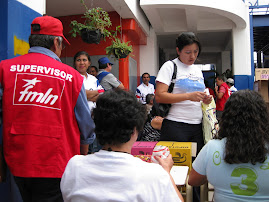
Most voting centers are in schools which are built in the Spanish style with the classrooms opening onto a courtyard. Voting tables, booths and ballot boxes are crowed together on the sidewalks in front of each classroom offering little privacy. Representatives from each party sit at a table and compare names with ID’s and distribute ballots in the same way election judges do in the U.S. Since there were two items to be voted on, the Legislative Assembly ballot was one color and the Mayor ballot another. After voting, the ballots were placed in the ballot box of the corresponding color.

After the polls close, the election officials open the ballot boxes one at a time, hold up each ballot for others to see and give the ballot to the member of the party indicated on the ballot. Then each party member counts the ballots for his/her party. At the table where I was observing the count was carefully double checked by other officials. However, I was told that other tables were not so diligent.

The process throughout the country was very peaceful. This is a positive change over past years. Members of the various parties joked around with each other and most disputes were settled peacefully. However, there were a number of examples of fraud and improper campaigning at the voting site.


Saturday, January 17, 2009

A Tale of Two Mayors

Wednesday, January 14, 2009


Election observers today had a choice of a number of field trips to various locales. I chose to visit two very different municipalities where we met with the mayor of each one. Our first visit was with Milagro Navas, the ARENA mayor of Antiguo Cuscatlan. ARENA is the far right political party which is in control of the central government at this time. However, Mayor Navas has overseen the development of a model community. She is fortunate that there is much wealth here, and she has chosen to invest in the community rather than pocket the wealth for her own benefit. Three embassies are located in the community, there are a large number of industries, unemployment is the lowest in the country and they have good schools. In order for a new business to locate here, they must agree that 50% of their employees come from this municipality. She claims that her municipality has the best water in the country and that they take care of trees and the land.


When asked how she came to have such power as a woman in a macho society, she said that she has to be a woman of strength as she works only with men. She said she was selected as the best mayor in the entire country, is Treasurer of the mayors association in El Salvador and is General Secretary of the organization of mayors of Central America.


As with most Salvadorans, her experience during the Civil War from 1980-1992 has influenced her political beliefs. Her family were large land owners in the area of Suchitoto at the beginning of the war. Part of their land was taken by the guerrilla forces, and they were forced to leave the area. She is opposed to the teaching of Oscar Romero and believes the church and priests should have nothing to do with politics.


The municipality of Suchitoto offers a distinct contrast to that of Antiguo Cuscatlan. We met with Mayor Javier Martinez of the leftist FMLN (Faribundo Marti Liberacion Nacional) political party. Mayor Martinez has also developed a model community but with far fewer resources to work with than Mayor Nivas. Its economy is primarily based on agriculture though tourism is growing here. Several women's cooperatives have been established in recent years. These cooperatives create embroidered textiles or candies and jellies made from native fruits. Others have revived the ancient art of dying cloth with indigo or making candles, shampoo and natural soaps. The municipality receives only 2% of its budget from the Salvadoran government. The rest comes from the international community from countries such as Spain.

Because Suchitoto was a main area of conflict during the civil war, many people left at that time and social structures such as schools, homes and roads were destroyed. Repopulation of the area began in 1989, and the first development plan was made in 1995. At first only 10% of families had electricity and 13% had potable water. Now 94% have electricity and 93% have water.

The municipality has a recycling program and sewage treatment. I was somewhat surprised that they have a 2030 Plan. Included in this plan for the future is putting pressure on the government of San Salvador and surrounding communities to clean up the river that flows into Lake Suchitlan, a beautiful but highly polluted lake near the city of Suchitoto.


Sunday, January 11, 2009

La Iglesia Bautista El Cordero de Dios

It was good to attend church this morning and reconnect with old friends. As I mentioned last year, this Baptist church is nothing like most of the Baptist churches in the United States. Today's sermon was about baptism. Tito, the pastor, said that baptism is only a symbol and that there are many symbols in the Bible. It is not enough to be baptized, take communion or participate in other rituals of the church. We must also serve and work for justice. He pointed out that there are 20 killings in San Salvador every week, poverty is great and prostitution and violence are rampant. He asked, "Where is the church? What is it doing to address these problems?" Those are questions we in churches in the US should also consider.

Celebrating the New Year in El Salvador

The man from whom I'm renting a room this year not only has a microwave and a washing machine and clothes dryer, but also owns a beautiful home on the beach. He invited Leslie, the Director of the CIS (the organization which sponsors election observations and has the Spanish and English Schools), 2 other election observers and me to spend New Year's Eve and Day at his beach home. So while most of you were covered with snow and shivering from the cold, we were sunning ourselves and enjoying the ocean breeze.
I've included a few photos in this post. Marvin, the only man in the group, is a gourmet cook and thus was delighted to prepare all our meals. He arranged our plates so that the food both tasted and looked great.

Sunday, March 9, 2008

A Visit to Co-Madres

Co-Madres is an organization formed in 1978 to help mothers locate their children and other family members who were disappeared before and during the war, which began at the end of 1979 and ended in 1992 with the signing of the Peace Accords. It was Oscar Romero, archbishop of San Salvador, who advised and encouraged the women to form a committee to look for the disappeared. At first they met in churches because at that time meetings were not allowed.

We met with Alicia, the sole surviving founder of Co-Madres. Alicia's 12 year old son and 2 of her brothers were disappeared in 1978. Her youngest son was killed in 1993-after the Peace Accords were signed-because he was documenting cases of the disappeared.

Co-Madres began by looking for clandestine cemeteries and digging up bodies and sending them to forensic labs for identification. However, that task was made difficult and sometimes impossible because of the condition of the bodies. Men with women's heads in their bellies and vice-versa were found. In some cases they found bones that were really white and others with some flesh still on the bones. It was evident that many people who were found hanging from bridges were actually killed elsewhere and hung from the bridge to make it appear as though they had committed suicide.

In 1983 the mothers began to wear black dresses and white scarves as they marched to demand that the government take responsibility for and stop the deaths and disappearances. Because of this and their continuing documentation of abuses, the women were arrested and tortured.

When Alicia began describing how someone was tortured, I thought she was talking about torture in general. She wasn't. She was telling what had actually happened to her. Though I've heard many stories like hers, I'm always amazed at how the tortured survive and are able to have optimism.

Alicia was tortured for 2 days. She was blindfolded during the entire interrogation. She heard the noises of several machines which sounded like bones were being cut and ground. "You're next," was what she was told. A plastic bag with lime in it was put over her head, and when she gasped for air the bag was removed and the process began again. She said she tried to pray the Lord's Prayer but couldn't. For hours she was placed on a bed with no mattress but with electrified metal coils. Her body was wrapped with an electrified metal chain. She was put in a pila with electrified water which caused her to bounce from wall to wall. She was deprived of sleep. The day she was released she was pushed from a moving car-naked and still blindfolded-onto the pavement. Fortunately she was found by some kind men who helped her get home in a taxi. Alicia said she has never lost faith and hope.

Although 80,000 people have been killed and 86,000 disappeared, no one has been punished for these crimes. El Salvador passed an amnesty law which gave impunity to the guilty. Co-Madres asked the Supreme Court to abolish the amnesty law, but it hasn't taken any action. This year the mothers will have a chance to present their case formally to the Court.

After 25 years of pressure the U.N. finally passed a convention to protect people from abduction. Thus far, 75 countries have signed the convention; El Salvador has not.

The Memorial to Truth is a wall in Cuscatlan Park in the center of San Salvador filled with the names of those killed or disappeared beginning in 1979. There are also blank plaques on which more names are added as they are identified. On March 15 at 2:00 p.m. new plaques will be unveiled by the committee.

Friday, March 7, 2008

Prosecution Appeals Definitive Liberty of Suchitoto 13

The following report comes from U.S.-El Salvador Sister Cities.

Prosecution Appeals Definitive Liberty of Suchitoto 13; Seeks to Resume Trial for Public Disorder and Aggravated Damages

March 6, 2008

The Prosecuting Attorney's have appealed the decision by a court in Suchitoto to grant definitive liberty to the 13 people captured on the 2nd of July 2007 in Suchitoto. Last Tuesday February 27th the Prosecution presented an appeal to the Suchitoto Court system, asking to re-open the trial for public disorder and aggravated damages against the Suchitoto 13. The Suchitoto 13 were cleared of all charges in a Suchitoto court on February 19th, in a decision that Salvadoran Human Rights Ombudsman Oscar Luna classified as "based on justice and ruled by principles of legality."

The seven page appeal document presented by the Prosecuting Attorneys argues that Suchitoto Judge José Mauricio Henriquez who oversaw the case misinterpreted the Penal Processing Law, and did not follow procedures established by that law when the Prosecution failed to arrive to the courthouse on time for the preliminary hearing of February 19th, 2008. According to the Prosecution, the hearing should have been rescheduled for a later date.

In addition, the appeal questions the observations made in a written resolution of February 26th by Judge Henriquez, and later reiterated by Ombudsman Luna, that the Prosecution did not act responsibly and thoroughly during the investigation of the Suchitoto 13 case. In his decision, Judge Henriquez detailed shortcomings in the investigation ranging from the Police's failure to preserve the scene of the alleged crime, inconsistent interview procedures of witnesses by the Prosecution, and the Prosecutions´ failure to present the proper documents to the court on time.

The Prosecutions´ appeal goes on to claim that the Suchitoto Judge violated the rights of the alleged victims of public disorder and aggravated damages by refusing to orally hear the Prosecutions´ case on the day of the preliminarily hearing. The Prosecution also alleges "subjectivity, partiality, lack of critical analysis, and lack of sane application of criteria" by the Judge, citing the 19 page document Judge Henriquez issued last week.

Yesterday, the Defense Lawyers for the Suchitoto 13 presented their own arguments in defense of the decision of the Suchitoto Court. The defense cited the resolutions´ respect for the rule of law and due process, its objectivity, impartiality, and the application of the right to be presumed innocent until proven otherwise.

In addition, the Defense Lawyers dispute the Prosecution's right to appeal due to their claim that the Prosecution never presented charges, written or spoken, to the Court Suchitoto. Citing the arguments made by Judge Henriquez, the Defense claims that the appeal is invalid, because there were never any charges filed to merit an appeal. The Prosecution maintains that documents that they presented to the Special Tribunal for acts of terrorism in San Salvador should be applicable in the ordinary penal courts as well.

The Prosecutions´ appeal will be reviewed by two Judges in Cojutepeque, who must come to an agreement within 10 weekdays about whether or not to reopen the case. If they decide in favor of the decision by the Justice of the Peace in Suchitoto, the case will be closed. If they decide to approve the Prosecutions appeal, the case will be reopened, and a preliminary trial will again be held, this time in the second appeals court of Suchitoto. If the two Judges cannot reach consent, a third Judge will be asked intervene in the decision.

-- US-El Salvador Sister CitiesP.O. Box 2543Plattsburgh, NY 12901(800) 532-1993, ext.103http://us.f814.mail.yahoo.com/ym/Compose?To=sistercities@gmail.comhttp://www.elsalvadorsolidarity.org/

Sunday, March 2, 2008

Fair Trade Delegation

For the past week I have been part of a U.S.-El Salvador Sister Cities Fair Trade delegation. We visited our sister communities as well as the coffee processing plant for coffee grown in the department of Chaletenango and met with the leaders of CORDES (Association for the Cooperation and Communal Development of El Salvador).

Others taking part in the delegation were Karen Volkhausen of Bangor, Maine/Carasque; Joan Laurion of Madison, Wisconsin/Arcatao; and Libby Pappalardo of Crystal Lake, Illinois/Chilama. Although Meredith DeFrancesco, of Maine radio station WERU, wasn't an official part of this delegation, we did meet with the staff of Radio Sumpul which is sistered with WERU. The main goals of this delegation were to learn what the various cooperatives in our sister communities are doing and ways in which we might help them market their products.


In Carasque and in Arcatao we met with the community councils and representatives of various cooperatives in those communities. Most of the cooperatives make items for sale in the U.S., Spain, and other countries as well as in El Salvador. The cooperatives are formed around a particular interest or art form such as sewing and embroidery, crochet, jewelry, wood crafts and music. Both men and women are members of these coops.

One women's cooperative in Carasque is especially interesting. With the assistance of Oxfam, the women began a savings and loan group. Each person in the group of 12-20 saves $2.00 per month. This may seem like a small amount, but when you consider that the average wage in El Salvador is $150 per month and many earn much less, it is a considerable amount. The group meets monthly, and anyone who is late for a meeting must pay a fine. The group not only saves money; they also grant loans with 1% interest. The idea for this came from a desire to own a business but lacking money to start. The community decided it would be better to form their own bank than to go outside the community.

Chilama has been part of Sister Cities for a much shorter time than Carasque and Arcatao. As a result, they lack the infrasturcture of those two communities. However, they have cooperated in a seed/road building project. After receiving $2,000 to purchase seeds from their Sister City, Friends of Chilama, in McHenry County, Illinois, the community decided to give money for seeds and fertilizer to those who worked on building a road from the top of the mountain to their community by the river. Those who were unable to work on the road because of age or ill-health would be given a portion of the crop. The crops were planted and harvested, the road is almost completed, and everyone has beans and corn to eat this year.

Both Carasque and Arcatao have received considerable financial aid from the governments of Spain and Canada. Wouldn't it be wonderful if the United States funded development projects in these and other very rural communities rather than a highway across northern El Salvador which benefits only the maquillas, which treat their employees as slaves, and the mining companies, which destroy the environment?